Why You Still Need the Basics When AI Writes the Code
AI can write code in seconds, but you still have to judge it. Here is why the basics matter more now, and how to learn them.
Today you can type a sentence into an AI tool and get working code back in a few seconds. A login page, a sorting function, a whole small app. It feels like magic, and honestly it is very useful. I use it too.
But here is the thing nobody says out loud. Getting code is easy now. Knowing if that code is any good is still hard. And that part only comes from knowing the basics.
The code runs, so it must be right?
Not really. AI code usually runs. That is the easy bit. The real question is whether it does the right thing, every time, for every user, without being slow or unsafe.
Say you ask for a function to find a user by email. The AI gives you a loop that checks every user one by one. It works fine with 50 users. With 500,000 users your app starts to crawl. If you know a little about data structures, you will spot it in ten seconds and ask for a hash map or a database index. If you don't, you will just see a slow app and have no idea why.
The AI did not make a mistake you can see. It made a choice you could not judge.
You are now the reviewer
Before, you wrote the code and then checked it. Now the AI writes it and you check it. That is a different job, and it is actually harder. Reading code you did not write takes more skill than writing your own.
To review code you need to know:
- What a variable, a loop and a function really do
- How data sits in memory and why that matters
- What a stack, a queue or a tree is good at
- How to read an error message instead of pasting it back and hoping
Without these, you can only say "it works" or "it doesn't work". With them, you can say why.
AI is a helping hand, and you decide how far it reaches
Think of AI as a helping hand with a huge store of knowledge behind it. It has read more than any person ever could. But a hand does only what the person gives it to do.
So you can only use AI as well as you understand the problem. If you don't know what to ask for, you ask for something small and vague, and you get something small and vague back. If you know the topic, you ask sharper questions, and you notice when the answer is off. The AI's knowledge is always big. Your knowledge is what limits how much of it you can actually use.
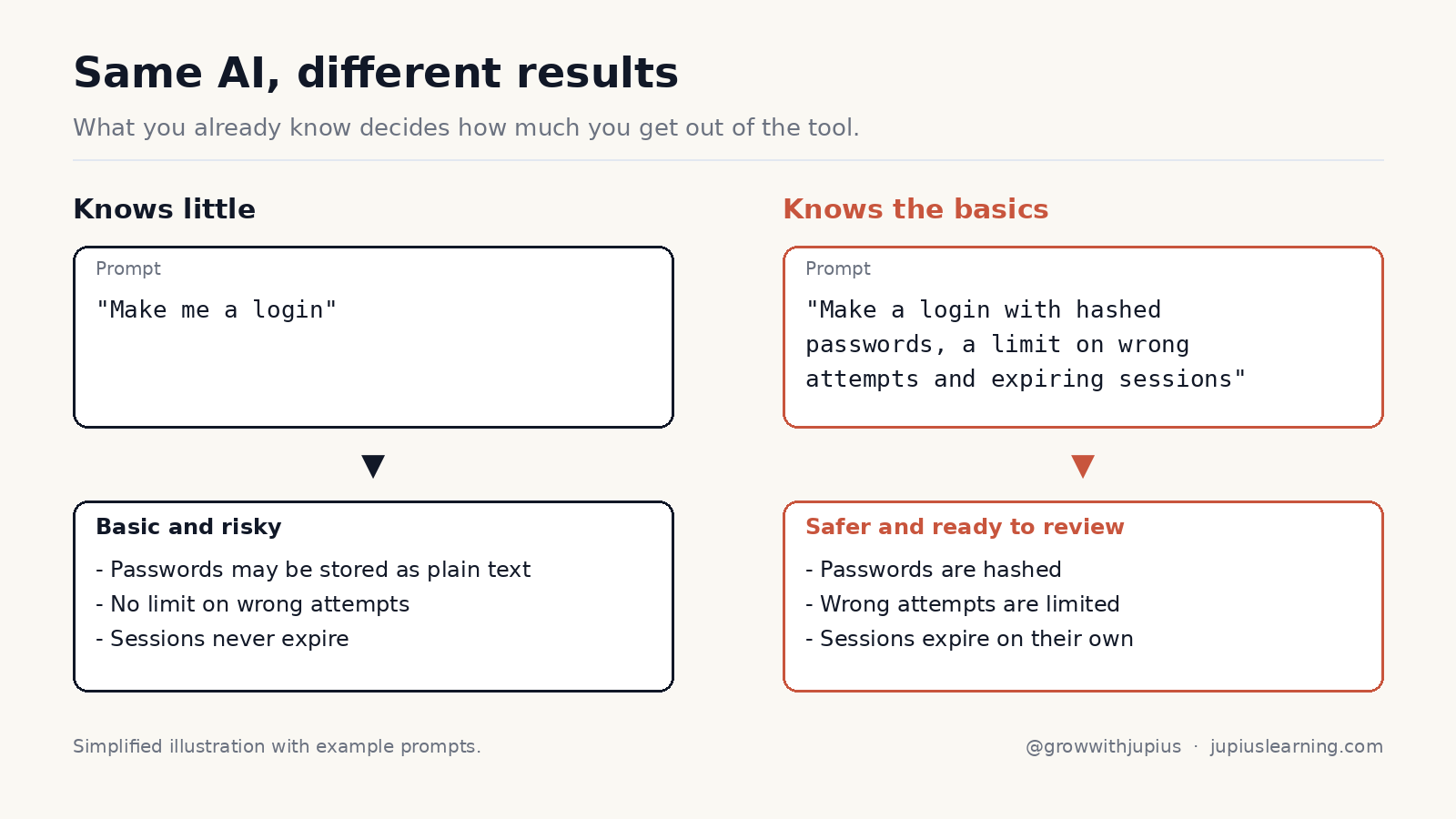
Two people can open the same tool and get very different results. One says "make me a login". The other says "make a login with hashed passwords, a limit on wrong attempts and a session that expires". Same AI. The difference is what each person already knows.
So if you want more from AI, the way to get it is to grow your own knowledge.
AI is confident even when it is wrong
This one surprises beginners. An AI tool never sounds unsure. It will give you a wrong answer in the same calm voice as a right one. It can invent a function that does not exist. It can use an old method that was removed years ago. It can leave a security hole and not say a word.
You are the only one in the room who can catch that. And you can only catch what you understand.
Debugging is where basics pay off
Sooner or later the code will break, and it will break in a way the AI cannot fix with one more prompt. Maybe the bug is in how two parts talk to each other. Maybe the data is not what you think it is.
This is when people who know the fundamentals stay calm. They add a print line, check the value, trace the flow and find the problem. People who skipped the basics paste the error again, get a new guess, paste again, and go in circles for an hour.
Interviews still test the basics
If you are learning to get a job, this matters a lot. Companies still ask you to explain how a hash table works, or when you would pick a queue over a stack. Some interviews even ask you to code without any AI tool. They want to know that you can think, not only that you can prompt.
So how should you use AI?
I am not saying avoid it. That would be silly. Here is what works better:
- Learn the basics first, even if it feels slow.
- Try a problem yourself before you ask the AI.
- When the AI gives you code, read every line. Ask it to explain the parts you don't get.
- Change something small and see what breaks. That is how you really learn.
Think of AI like a calculator. A calculator did not make maths useless. It just means you can skip the boring sums. But if you don't understand maths, you won't even know when the calculator gave you a silly answer.
The short version
AI has made writing code cheap. It has made understanding code more valuable. The people who do well in the next few years will not be the ones who type the best prompts. They will be the ones who know enough to tell good code from bad code.
That is why we are starting this series with fundamentals. Next up, we go through the data structures one at a time. If you want to practise as you read, our C and data structures course is a good place to begin.